
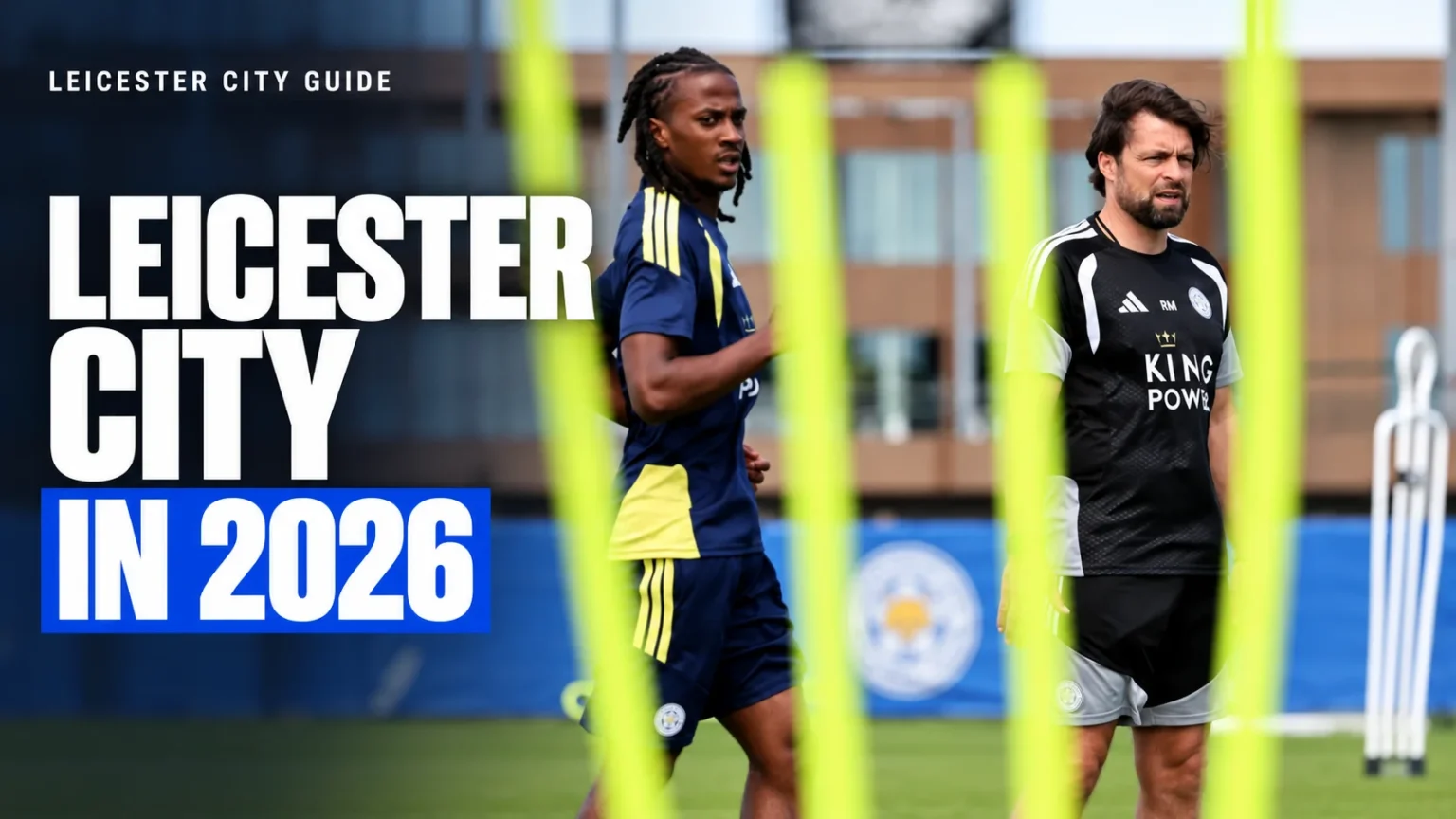
Leicester City are playing in League One in the 2026/27 season, ten years after winning the Premier League. Russell Martin is the men’s first-team manager, and home matches are played at King Power Stadium.
Those facts tell a different story from the one many casual football fans remember. The 2016 title made the Foxes famous around the world, but it did not guarantee a permanent place in the top flight. After promotions, relegations and another major trophy, Leicester City are now trying to rebuild in England’s third tier.
Why are Leicester City in League One?
The club dropped out of the Premier League at the end of the 2024/25 season. A second relegation, from the Championship in 2025/26, took the men’s team into League One for 2026/27. It is their first season at that level since 2008/09.
That rapid fall is why the current campaign attracts attention beyond the club’s usual supporters. King Power Stadium hosted a Premier League trophy celebration in 2016; it now hosts third-tier league fixtures. The contrast is striking, but the 2016 team and today’s squad are separated by a decade of changes.
League One also presents a different challenge from the one Leicester City faced during their title-winning season. A club’s reputation does not earn points, and promotion is not automatic. Results over a long league campaign will matter more than memories of where the Foxes once played. Supporters looking for the latest opponents and dates can check the club’s official fixtures and results.
The title that changed everything
Leicester City’s 2015/16 Premier League win remains one of English football’s most remarkable achievements. Managed by Claudio Ranieri, the team finished above clubs with far greater recent experience of competing for the title.
Jamie Vardy’s goals were central to the campaign, while Riyad Mahrez supplied creativity and N’Golo Kanté gave the midfield extraordinary energy. Captain Wes Morgan and goalkeeper Kasper Schmeichel were among the other key figures. It was an effective team, not simply a collection of individual performances.
The title also changed how people outside Leicester saw the club. Before 2016, the Foxes had a long history of movement between divisions. Afterwards, their name became shorthand for the possibility of an outsider beating the established powers.
That story deserves its place in football history. It can, however, obscure what followed. The players moved on, managers changed and the demands of maintaining a top-flight squad continued. For the present team, the title is part of the club’s identity, not a description of its current position.
There was more than one trophy
The Premier League is the most famous item in Leicester City’s honours list, but it is not the only one. The club won its first FA Cup in 2021, beating Chelsea 1–0 in the final. Youri Tielemans scored the decisive goal.
Leicester City have also won the League Cup three times and claimed multiple second-tier titles, most recently in 2024. The 2021 FA Cup matters particularly because it showed that the success of the 2010s had not been confined to one extraordinary league season.
There were European nights too. After winning the Premier League, the Foxes reached the Champions League quarter-finals in 2016/17. Those achievements explain why the move to League One feels so dramatic: this is a club whose supporters have experienced both major national trophies and elite European competition within the past decade.
Who is managing Leicester City?
Russell Martin was appointed men’s first-team manager in June 2026 on a contract running until 2029. The former Scotland international arrived with coaching experience at MK Dons, Swansea City, Southampton and Rangers.
His appointment marked the start of a new phase following relegation. Building a team suited to League One is not just a question of selecting players with the strongest past records. The manager must establish a reliable way of playing, get results against varied opponents and give supporters signs that the club is moving forward.
That work will be judged across the season rather than by one match. It is reasonable to see promotion as a major ambition for a club with Leicester City’s recent history, but ambition should not be mistaken for a forecast. The league table, rather than the club’s name, will decide what happens next.
The club behind the headlines
Leicester City began as Leicester Fosse in 1884 and adopted its current name in 1919. The Foxes played at Filbert Street for 111 years before moving to the stadium now known as King Power Stadium in 2002. The ground holds a little over 32,000 spectators.
Those roots help explain why the club’s story is bigger than the 2016 title or the latest relegation. Generations of supporters knew Leicester City before the Premier League triumph, and they continue to follow the team through its current difficulties.
As of October 2026, the answer to “where are Leicester City now?” is straightforward: the men’s team are in League One under Russell Martin. The longer answer is still being written. This season will show whether the Foxes can turn another difficult chapter into the beginning of a recovery.